So, you’re ready to invest. You’ve saved up some money, you’ve heard it’s the key to building wealth, and you know you need to make your cash start working for you.
But the moment you decide to start, you hit a wall of jargon. You log into a brokerage account and see terms like mutual funds, ETFs, index funds, stocks… What’s the difference? And where in the world are you supposed to put your money first?
Let’s take a deep breath. It’s not as complicated as it looks.
For the vast majority of beginners, the choice boils down to two fantastic, nearly identical options: Index Funds and ETFs. This guide is going to break them down in plain English. No confusing charts, no Wall Street jargon. By the end of this, you’ll know what they are and which one is right for you.
The Big Idea They Both Share: “Buying the Whole Market”
Before we compare them, let’s talk about the powerful concept they both share.
Forget about trying to pick the next winning stock, like Apple or Amazon. That’s like trying to find the one perfect avocado in a giant supermarket. It’s hard, and you’ll probably get it wrong.
Instead, an index fund or an index-based ETF allows you to buy the entire shopping cart.
The most famous “shopping cart” is the S&P 500. It is simply a list of the 500 largest and most successful public companies in the United States. When you buy an S&P 500 index fund or ETF, you are buying one single thing that holds tiny slices of all 500 of those companies.
You are instantly diversified. You’re no longer betting on one company to succeed; you are betting on the entire American economy to grow over time. History has shown this to be the simplest and most reliable way for everyday people to build wealth.
Both Index Funds and ETFs are brilliant ways to do this.
So… What’s the Real Difference?
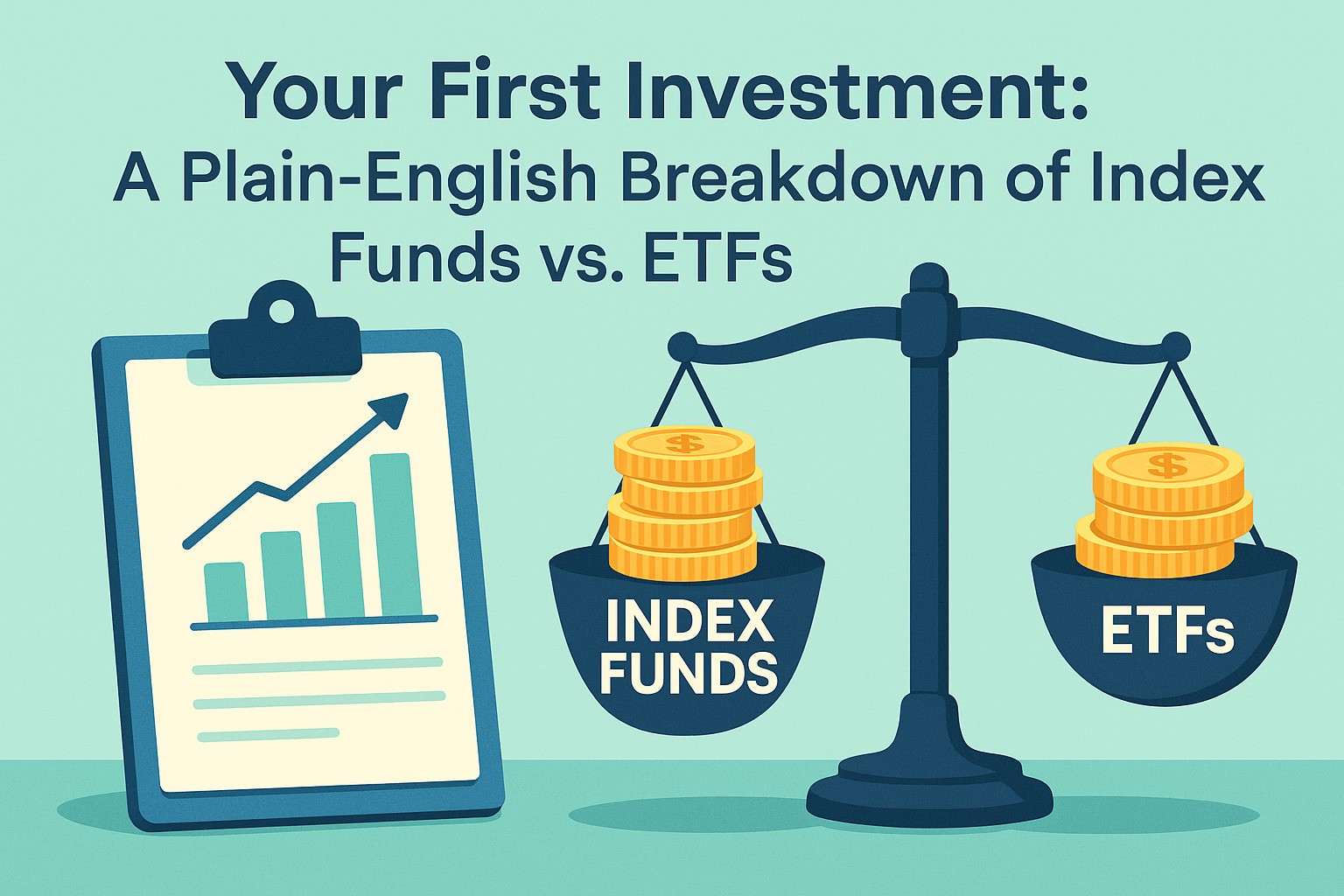
Okay, here’s the big secret the financial world doesn’t really want you to know: For a beginner, the difference between an Index Fund and an ETF that tracks the same index is tiny.
They are like two different pizza shops that use the exact same ingredients, the same recipe, and produce a nearly identical pizza. The only real difference is in how you order it.
The Traditional Index Fund (a type of Mutual Fund)
Think of this like ordering a pizza for delivery at the end of the day.
You place your order (invest your money) anytime during business hours. However, all the orders are processed together and you get the price that’s set once the market closes for the day. Everyone who bought that day gets the exact same price. You can also usually set up automatic orders, like “send me a $100 pizza every Friday,” which is great for automatic investing.
Key features:
- Priced and traded only once per day after the market closes.
- Often have a minimum investment amount to get started (e.g., $1,000 or more, though this is changing).
- Fantastic for disciplined, “set it and forget it” automated investing.
The ETF (Exchange-Traded Fund)
Think of this like buying a hot slice of pizza from a street cart.
The cart (the stock market) is open all day. You can walk up at 10 AM, 1 PM, or right before closing and buy a share (a slice). The price of that slice changes constantly throughout the day based on supply and demand, just like a stock.
Key features:
- Traded all day long on the stock exchange. The price fluctuates.
- You can buy as little as one share, making the starting cost much lower.
- It offers more trading flexibility (which, for a beginner, you don’t really need).
The Showdown: Which One is Right for You?
This isn’t about which one is “better” overall, but which one fits your style.
You might prefer a traditional INDEX FUND if…
- You are a classic “set it and forget it” investor. You want to automatically invest $200 every month from your paycheck and not think about it.
- You are easily tempted to check your investments and trade emotionally. A once-a-day price can help curb impulsive decisions.
- You have a larger lump sum (like $3,000) ready to invest and can easily meet the fund’s minimum.
You might prefer an ETF if…
- You are starting with a smaller amount of money. The ability to buy just one share for, say, $400 makes it very accessible.
- You are using a modern, mobile-first brokerage app like Robinhood or Webull, as their platforms are built around the real-time trading of stocks and ETFs.
- You like the idea of seeing a real-time price for your investment throughout the day.
The Bottom Line: Just Pick One and Start
Here is the most important piece of advice in this entire article. Please read it twice.
The difference between these two products is microscopic compared to the massive importance of simply starting to invest.
Seriously. It’s like debating whether to start your fitness journey by jogging or by using an elliptical. It doesn’t matter. Just pick one and start moving. The cost of waiting on the sidelines in confusion is infinitely higher than the tiny functional differences between a low-cost Index Fund and a low-cost ETF.
Find a fund or ETF that tracks a broad market index like the S&P 500. Check that it has a low expense ratio (the fee should be very small, like under 0.10%).
Then, buy it. And keep buying it, consistently, for a very long time. That’s how you win the game.