You start the month with a beautiful spreadsheet. Every single dollar has a name, a home, a purpose. You feel organized, you feel in control.
Then, by the 15th, life happens. An unexpected dinner with friends, a car repair, and an impulse buy have blown your perfect categories to pieces. You feel a wave of guilt, you get frustrated, and you utter the famous five words: “I’ll try again next month.”
Sound familiar?
Here’s the secret the budgeting gurus don’t often tell you: You didn’t fail the budget. The budget failed you.
Traditional, line-by-line, penny-tracking budgets often fail because they are rigid, tedious, and they work against basic human psychology. They focus on restriction, which makes you want to rebel. The good news is there are smarter, more flexible ways to manage your money. These methods are less about tracking every last coffee and more about aligning your spending with your actual life and goals.
Let’s look at three powerful alternatives.
The 50/30/20 Rule: The “Big Picture” Budget
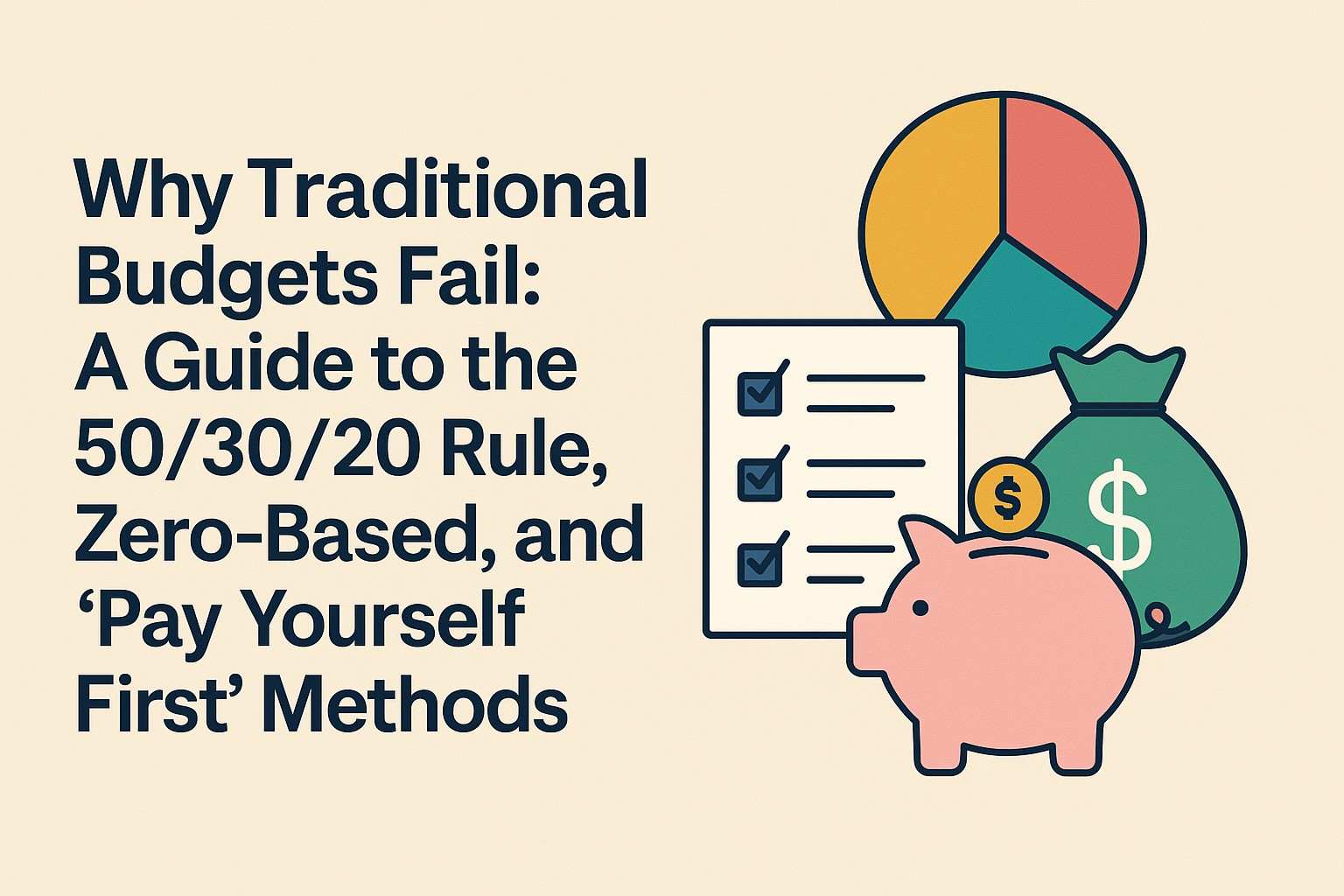
This isn’t about tracking every tiny transaction. It’s about making sure your big rocks are in the right piles. It’s beautifully simple. You take your after-tax income and divide it into three buckets.
50% for Your Needs. This category is for the absolute essentials. The things you must pay to live.
Rent or Mortgage
Utilities (electricity, water, internet)
Groceries
Transportation (car payment, gas, public transit)
Insurance
30% for Your Wants. This is the fun stuff. The category that makes life enjoyable.
Dining out and entertainment
Hobbies and shopping
Travel and vacations
Streaming subscriptions
20% for Savings & Debt Repayment. This is the “Future You” bucket. It’s arguably the most important.
Building your emergency fund
Investing for retirement
Making extra payments on high-interest debt (like credit cards or personal loans).
Who is this for? This method is perfect for people who hate detailed tracking. It gives you a simple framework for a balanced financial life and provides freedom within clear boundaries. As long as you keep your “Wants” around 30%, you don’t need to feel guilty about that dinner out.
Zero-Based Budgeting: The “Every Dollar Has a Job” Method
Okay, if 50/30/20 is for the “big picture” people, this one is for the hands-on planners who want maximum control and clarity. The concept is simple, but it requires more effort.
The formula is: Income – Expenses = Zero.
Here’s how it works. At the beginning of the month, you take your total expected income. Then, you assign every single dollar of that income to a category—bills, groceries, gas, savings, investments, fun money—until there is nothing left. You are giving every dollar a mission before the month even starts.
This doesn’t mean you have zero dollars in your bank account. It just means that all your income has been accounted for on paper. If you have $400 left after all your bills are assigned, you might decide to assign “$200 to Savings” and “$200 to ‘Guilt-Free Spending’.” Now your budget equals zero.
Who is this for? This is ideal for people with variable incomes (like freelancers) or anyone who constantly asks, “Where did all my money go?” It forces you to be intentional and eliminates mindless, “leaky” spending.
Pay Yourself First: The “Automated Success” Method
This is the simplest method of all. In fact, it’s almost an “anti-budget.” It’s designed for people who truly despise budgeting but are serious about building wealth.
The philosophy is radical in its simplicity: Before you pay your rent, before you buy groceries, before you do anything else… you pay your future self.
It works in two steps:
Decide your savings goal. Choose a percentage of your income you want to save (e.g., 15%).
Automate it. Set up an automatic transfer to move that exact amount of money from your checking account into your savings or investment account the very day you get paid.
After that transfer happens? The rest of the money is yours to manage however you see fit. As long as you can pay your essential bills with what’s left, you have complete, guilt-free freedom with the remainder. No tracking, no categories.
Who is this for? This is perfect for people who want to put their major financial goals on autopilot and not stress about every small purchase. It prioritizes what’s most important (your future) and then gets out of the way.
Conclusion: A Budget That Works With You, Not Against You
The perfect budget doesn’t exist. The best budget is the one you can actually stick with for more than a few weeks.
Stop trying to force yourself into a rigid system that doesn’t fit your personality. Look at the options above. Does one resonate more than the others? Pick that one. Give it an honest try for two or three months.
The goal isn’t to be a perfect bookkeeper. The goal is to create a system that helps you achieve your goals with the least amount of stress. It’s about progress, not perfection.